
When the Transmitter Adds Noise to the Signal
A study co-authored by Tokgöz Lab researcher Mahir Burak Usta examines when noise from a transmitter's own electronics can limit wireless link performance—and how engineers can account for it.
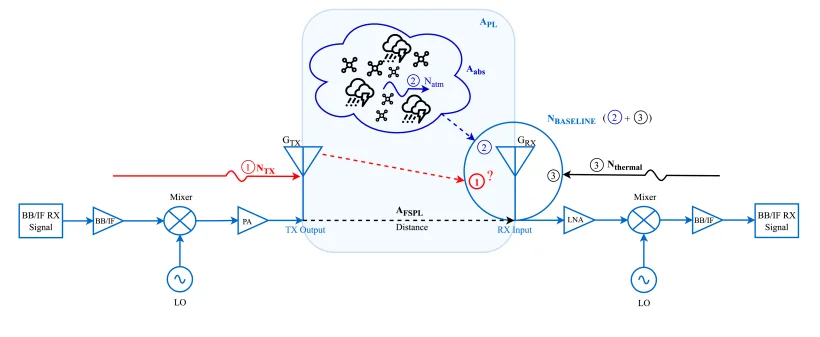
A wireless receiver never hears a perfectly clean signal. Alongside the information it is meant to receive, it also picks up noise. Engineers must estimate this noise when designing a communication link, because it affects how reliably the system can carry data. But some of that noise begins at the other end of the connection: inside the transmitter itself.
A paper published in the IEEE Open Journal of the Communications Society, with Mahir Burak Usta as first author, investigates this often-simplified part of wireless system design. Titled “Transmitter Noise Propagation in Millimeter-Wave and Sub-Terahertz: From Limits to Design Guidelines,” the study examines how noise generated by transmitter electronics travels with the intended signal and affects the receiver.
Millimeter-wave and sub-terahertz systems operate at very high frequencies. When estimating their performance, engineers commonly account explicitly for noise generated inside the receiver, while treating transmitter noise as part of a broader design margin. This study asks when that simplification can overlook a meaningful limit on link quality.
The researchers developed an analytical framework that follows transmitter-generated noise through the communication link. It accounts for the transmitter’s electronic stages, antenna gains, signal spreading, atmospheric absorption, and operating bandwidth. Together, these factors determine how much transmitter noise reaches the receiver. Comparing that amount with the noise already present at the receiver shows how strongly it affects the signal-to-noise ratio—a measure of how clearly the useful signal stands out from background noise.
The findings show that distance alone does not determine whether transmitter noise matters. In the short-range configuration examined, which used low-gain antennas, the predicted signal-to-noise ratio penalty reached approximately 13–18 decibels at millimeter-scale separations within the model’s valid operating range. The effect then declined rapidly, falling below 0.1 decibel within 10 centimeters for the four frequencies evaluated.
Longer links present a different picture. The 100-meter and 1-kilometer configurations examined used high-gain antennas, which boost the transmitter noise along with the signal. Transmitter noise therefore still had a meaningful effect, especially at lower frequencies such as 60 and 140 gigahertz, and in these configurations the penalty at 1 kilometer was even larger than at 100 meters. At higher frequencies the effect was generally small, and at 1 kilometer atmospheric effects remained the main limitation overall.
All reported penalties are computed relative to an idealized receiver that adds no noise of its own; a practical receiver would see a smaller relative effect. The results also depend on the hardware, antennas, frequency, and atmospheric conditions; they are not a universal penalty for every link.
The study also derives an analytical criterion, expressed as a path-loss threshold, for identifying when transmitter noise needs explicit attention. This gives engineers a way to assess its importance early in the design process and make better-informed choices about hardware and link configuration.
About Mahir Burak Usta
Mahir Burak Usta is a Ph.D. student in electronics engineering at Sabancı University, where he received his B.S. degree in electronics engineering in 2022. He is a Graduate Student Member of IEEE. His research interests include noise in millimeter-wave and sub-terahertz systems, UAV-to-UAV communications, and reconfigurable antenna arrays. He is the first author of the study featured here.
Publication
Mahir Burak Usta, Didem Aydoğan, Evgenii Vinogradov, Mohammad Shahmoradi, Eduard Alarcón, Sergi Abadal, and Korkut Kaan Tokgöz. “Transmitter Noise Propagation in Millimeter-Wave and Sub-Terahertz: From Limits to Design Guidelines.” IEEE Open Journal of the Communications Society, vol. 7, pp. 11132–11153, 2026.